What they actually run
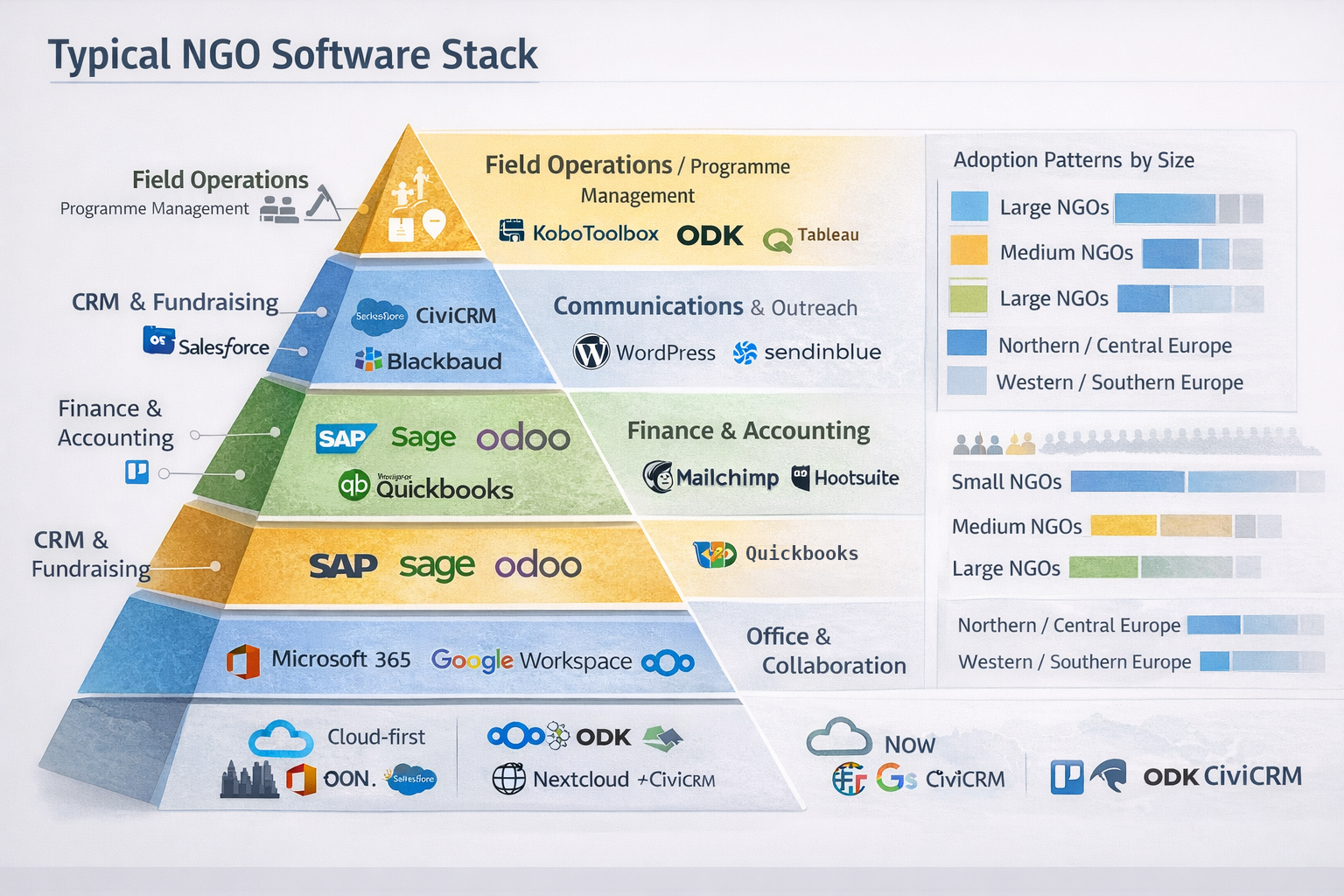
The technology stack of an NGO is never planned from first principles. It accumulates, layer by layer, as each new need produces a new solution, and the solutions gradually develop relationships with each other that nobody designed and everyone relies on. By the time anyone looks at the full picture, it is usually too late to redesign it cleanly. The goal is to understand it.
Office productivity, and the email question
Every NGO needs email and somewhere to put files. These two requirements drive the first major infrastructure decision, and the answer shapes everything that follows.
Microsoft 365 is the most common answer for medium and large organisations, partly on the strength of the nonprofit grant programme, which provides access to the full suite at a price that is genuinely hard to argue with. Google Workspace is equally common among smaller organisations and advocacy groups, particularly those with a preference for simple browser-based tools and a staff profile that skews younger. Some organisations use both, because one department adopted one platform and the rest of the organisation adopted the other and nobody ever resolved the tension. This is more common than vendors would like to admit.
Document collaboration sits on top of whichever productivity platform was chosen, with a layer of project management tools added by whichever team felt the need. Trello, Asana, Notion, and their various competitors appear in most organisations at some scale, rarely chosen centrally and rarely governed. They are where the work actually happens, which makes them worth understanding even if they were never formally approved.
CRM, and the question of where the data actually lives
Donor and membership management is the function most likely to involve a system that someone purchased, configured, and then handed over to people who were not involved in either the purchase or the configuration. The result is a CRM that does what was specified, mostly, and is used for things that were not specified, also mostly.
Salesforce Nonprofit Cloud is the enterprise-tier answer: powerful, customisable, and maintained by a small industry of consultants who specialise in it, because customisable also means complex. CiviCRM is the open-source answer, widely used across Europe in organisations that cannot afford the Salesforce licensing or the consultants and are willing to invest staff time in maintenance instead. The third answer is whatever the sector-specific system is, because many parts of the nonprofit world have purpose-built software that handles donor management as part of a broader operational function: residency management, case management, or volunteer coordination, depending on the mission.
The common factor is that the CRM is usually not integrated with the identity management system, because integration projects cost money that the organisation did not have at the moment it was needed. This means joiners, movers, and leavers are handled in two separate processes, and occasionally in one process and not the other, and occasionally in neither.
Finance, which is its own world
Accounting for NGOs is complicated by the need to track restricted funds, handle multi-year grants with reporting obligations, and comply with whatever the national regulatory framework requires. The finance team has almost always had more influence over the finance system than IT, which means the finance system was selected, configured, and is maintained by people who understand accounting rather than infrastructure. This is not unreasonable. It does produce some interesting gaps.
The results range from SAP installations at large, well-funded organisations to QuickBooks at small ones, with Sage Intacct, Exact Online, and various national-market systems in between. Unit4 is common in the Nordics. Somewhere in almost every organisation, regardless of what the official system is, there is also Excel. It is used as the intermediate format between the system that generated the data and the report the funder wants to see.
The security implications of the finance system are underappreciated. It holds bank details, salary information, and payment credentials. It is often accessed via methods that would not be considered acceptable for less sensitive data. It is not always integrated with the main identity management system. It is sometimes the oldest system in the estate.
Communications, which is its own other world
NGOs that rely on public support rely on communications, and communications tools are chosen by the people who use them rather than the people who govern the IT estate. Mailchimp is ubiquitous for email marketing. Brevo, formerly known as Sendinblue, has gained ground in Europe partly on the strength of its EU data residency positioning. Website CMSs range from WordPress, which is everywhere and maintained with varying degrees of attentiveness, to Drupal, which is technically superior and maintained by people who know what that means, to Squarespace and Wix, which are used by organisations that want a website and not a systems administration project.
Social media management tools sit on top of whatever platforms the communications team has decided are worth the effort. The accounts themselves are governed by whoever set them up, and it is worth establishing who holds the credentials before the person who holds them moves on.
Field operations, for those who have them
Humanitarian, development, and environmental NGOs often need to collect data in places where the infrastructure is unreliable. KoBoToolbox and ODK Collect are the standard answers for survey and data collection: both open-source, both designed to work offline and synchronise when connectivity is available. GIS and mapping requirements produce QGIS for those with budget constraints and ArcGIS for those without. Power BI and Tableau appear at the reporting layer, alongside Metabase and Superset for organisations that prefer open-source alternatives and have the staff to support them.
Field operations produce data security problems that are harder than office ones: devices crossing borders, data collected about vulnerable populations, offline storage that needs to synchronise through channels that may not be trustworthy. The field operations stack deserves its own security assessment, separate from the office environment, and often does not get one.
Cloud, on-premises, and the hybrid middle
Most NGOs that were established before 2015 have something on-premises that has not been fully migrated. It might be a file server, a line-of-business application with no cloud equivalent, or an integration that was built to run on local hardware and has never been moved because moving it was always the next project. The hybrid environment that results is not a design choice. It is a historical record.
Cloud-first organisations, particularly those that started with Google Workspace or M365 and never had on-premises infrastructure, are simpler to audit and simpler to secure. The surface is well-defined. The providers maintain the underlying infrastructure. The configuration is the responsibility of whoever was given the admin credentials, which introduces its own set of questions, but at least the questions are knowable.
The honest picture is that most organisations of the Home’s size and age have both: a cloud tenant that is reasonably well understood, and a few on-premises artefacts that are considerably less so, doing something that probably matters and that nobody wants to be responsible for switching off.
This is not a failure of planning. It is what planning looks like when the plans are made under pressure, with the resources available, by people who were trying to keep the Home running while also keeping the thing in the basement fed.
Last updated: 21 March 2026