Europe’s NGO landscape
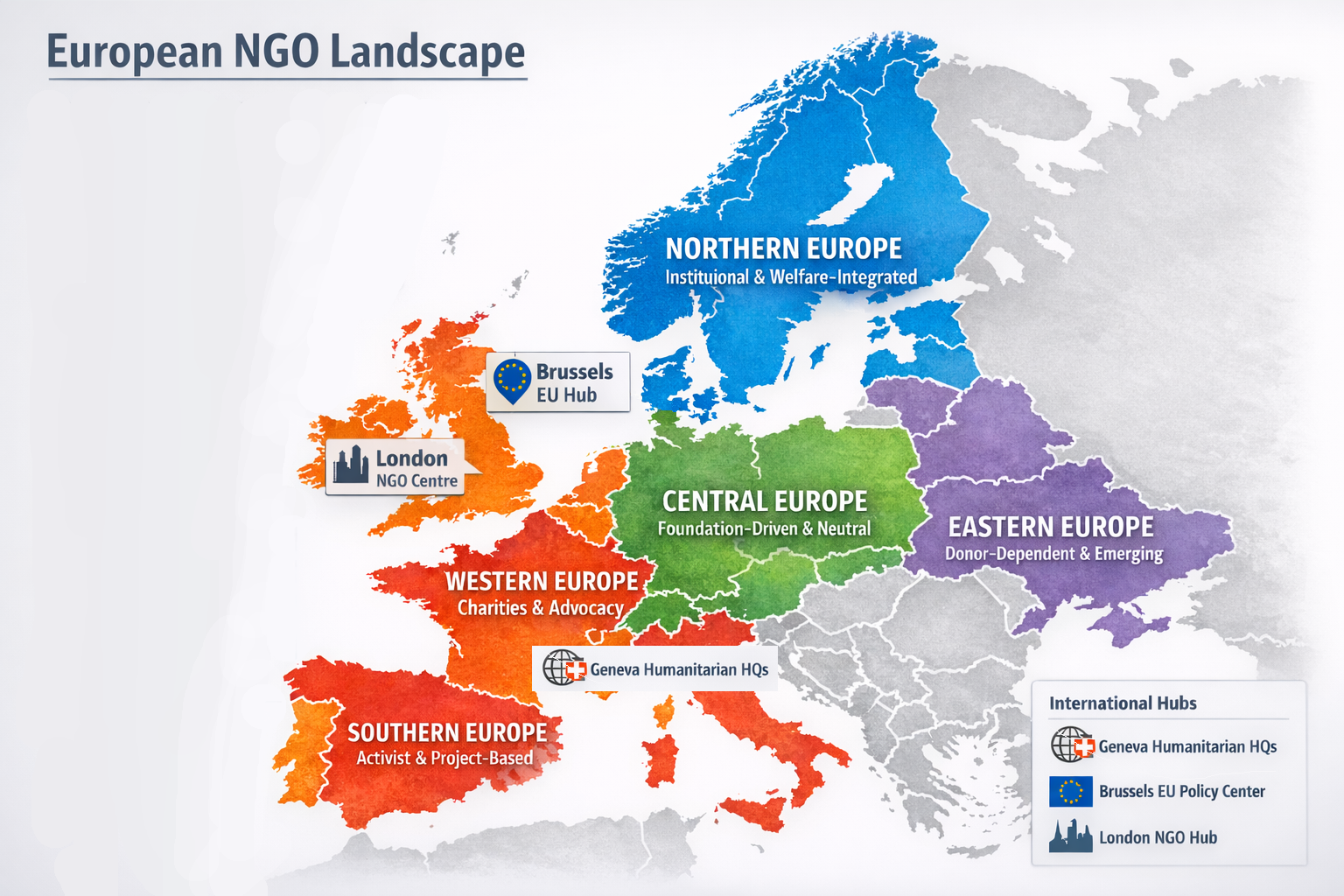
Europe’s NGO sector is not a sector so much as a contested geography, shaped by centuries of different legal traditions, welfare state experiments, political turbulence, and varying enthusiasm for the idea that private citizens should organise to change things. There is no standard model. There is a Scandinavian NGO that behaves like a small government department, and a Spanish advocacy group that runs on idealism, EU project funds, and a flexible relationship with the concept of the deadline. Both are legitimate. Both are representative. Neither would entirely recognise the other as quite the same kind of thing.
Understanding this diversity matters because an organisation’s legal and cultural context shapes everything downstream: how it is funded, how it thinks about governance, how it handles data, and how it approaches security. A Finnish welfare-integrated association with multi-year state funding has a very different risk posture from a French pressure group that assembles its budget annually from a rotating cast of foundations. The infrastructure reflects the stability, or the uncertainty, of the money.
Legal structures and what they signal
The legal skeleton of an NGO tells you a great deal. In France, Spain, Italy, and Austria, the association model dominates: member-led, often volunteer-heavy, rooted in civic participation. These organisations tend to be small to medium, close to their communities, and structurally resistant to becoming too professional, sometimes by design and sometimes by necessity.
Germany, Switzerland, Luxembourg, and the Nordic countries host well-endowed foundations with long mandates and international ambitions. These are different animals. They plan in decades. They have the resources to do things properly, which also means they have the resources to build the kind of technical debt that only becomes visible when something expensive needs replacing. Large, stable organisations have a particular talent for inheriting their own past decisions.
The UK and Ireland operate on the charity model: formally registered, fundraising-driven, with professional boards and regulatory oversight detailed enough to keep several solicitors occupied. The fundraising culture is aggressive in the polite sense. Donor acquisition, retention campaigns, and legacy giving are treated with the same professionalism applied to product marketing elsewhere, which produces sophisticated communications infrastructure and, sometimes, a gap between the outward-facing polish and the internal IT reality.
Italy and Spain have produced their own creative legal variants in the ONLUS and ONGD structures, and Switzerland has developed SDG-focused foundations designed to maximise impact while navigating tax and donor landscapes efficiently. These are admirable. They are also occasionally baffling to anyone trying to understand the governance from the outside, which is its own kind of security consideration.
Money and what it does to an organisation
Funding is arguably the most important variable, because it determines how much planning is possible and how much of the organisation’s energy goes into securing next year’s survival.
Welfare-integrated NGOs in Germany, Austria, and the Nordics receive stable, often multi-year government funding. The good news is predictable income and the ability to plan. The other news is that bureaucratic oversight comes with it, reporting requirements shape what is possible, and the relationship with the state creates dependencies that can feel constraining when political priorities shift. These organisations tend to have strong process cultures, because the funders require it, and their IT environments often reflect that: more structured, more standardised, and with clearer ownership than you find elsewhere.
Switzerland and Luxembourg host foundations operating from endowments: long time horizons, predictable income, and the freedom to pursue international agendas without the constant renegotiation of resources. This is comfortable, and comfort occasionally produces an institution that has not reconsidered its own assumptions in some time. Stability is an asset. It can also be an anaesthetic.
In France, Spain, and Italy, project-based funding dominates. EU grants, national co-financing, private foundations, and occasional corporate partnerships are assembled into patchwork budgets that have to be rebuilt constantly. The organisations that survive this environment are genuinely nimble. They are also, not infrequently, exhausted. Their IT is often an afterthought because IT requires sustained investment, and sustained investment is precisely what the funding model does not reward.
UK and Irish charities have turned donor engagement into a professional discipline. The marketing function, the events calendar, and the social media strategy are central operations. Cash flow depends on them directly. The result is sophisticated outward-facing infrastructure and, often, internal systems that have been deferred in favour of the next campaign.
How NGOs express themselves
Style of advocacy varies as much as legal structure. Southern and Western Europe favour the direct approach: public campaigns, media visibility, street presence, and the willingness to say uncomfortable things loudly. In France, the idea that civil society should challenge power is not controversial; it is the point. This produces organisations with strong communications instincts and occasionally chaotic internal governance.
Germany, Austria, and Switzerland prefer a more structured mode: research-driven advocacy, lobbying, court filings, and the long game of institutional influence. The output is less dramatic and often more durable. The approach tends to produce organisations with more considered internal governance, partly because the funders expect it and partly because the culture does.
Geneva and Brussels are categories unto themselves. The organisations headquartered there operate as nodes in international networks, blending advocacy with diplomacy, multilateral coordination, and a particular talent for appearing reasonable in several languages simultaneously. Their security posture is usually more mature than their size might suggest, because their stakeholders include governments and their adversaries occasionally do too.
Scale and what it means in practice
European NGOs range from two people with a mission and a shared inbox to organisations with thousands of staff and global operations. The small and volunteer-heavy ones, particularly in peripheral countries and rural areas, are highly local, highly adaptive, and highly vulnerable. They often lack the capacity to have IT as a distinct function. It is handled by whoever is available, which is usually someone who did not sign up to be a systems administrator.
Large and highly professionalised operators, concentrated in Germany, Switzerland, the UK, and the Netherlands, have formal governance, full-time IT staff, and international standardisation. They face different problems: the complexity of multi-entity structures, multi-currency accounting, data residency across jurisdictions, and the challenge of securing a large attack surface with a security team that is never quite large enough.
Most organisations fall somewhere in the middle, which is where the most interesting problems are, and interesting is being used honestly here. They are too large to run on good intentions and too small to afford everything they need. They have outgrown informal structures without quite building formal ones. They have a CRM selected under pressure, a cloud tenant that grew organically, and an IT function doing its best with the budget and hours available.
This is the landscape the Home inhabits. It is not exceptional. It is representative.
Last updated: 10 July 2026