Signals intake, correlation hold
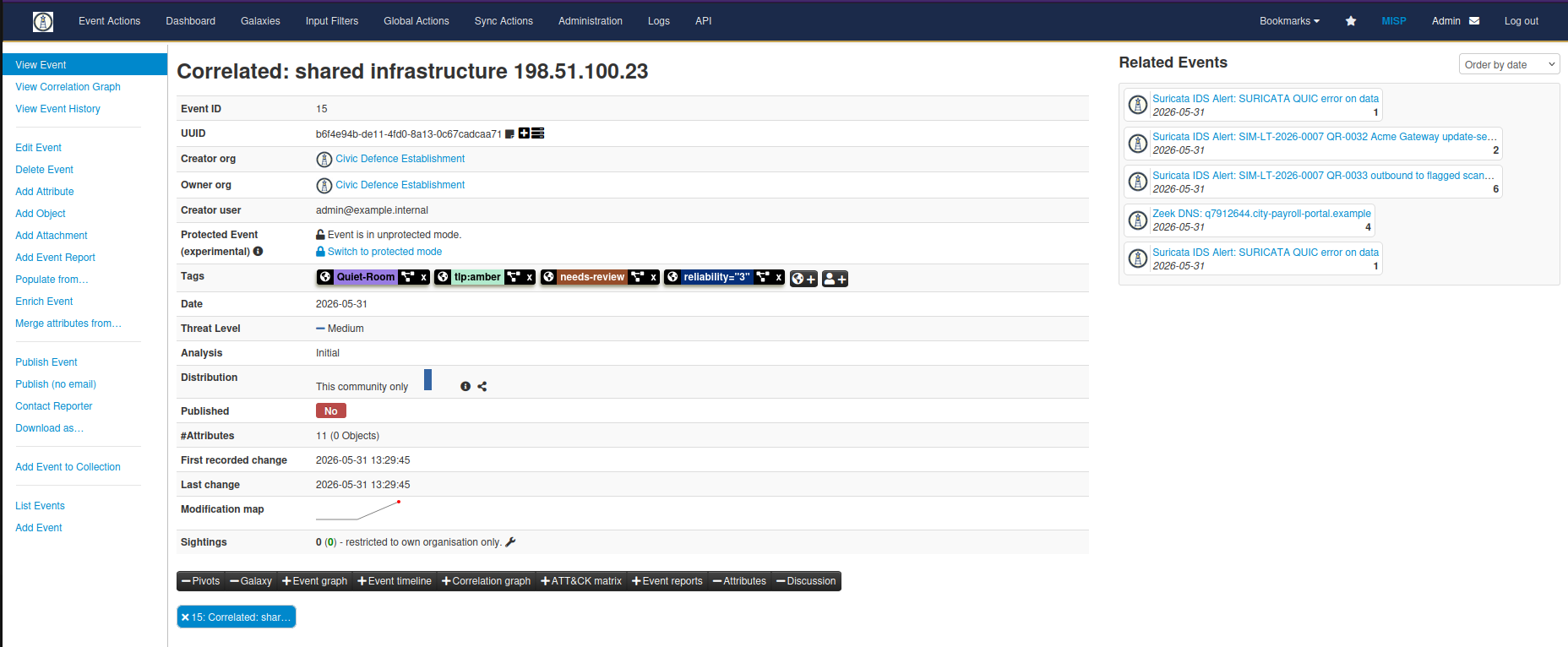
This walkthrough follows two events that arrive low and leave together and are held for analyst review: The tag bar: Quiet-Room, tlp:amber, needs-review, reliability=”3”, and no Long-Table yet; the merged attributes: the shared internal host 198.51.100.23, the external range 203.0.113.45, and the lookalike payroll domain.
Some material is worth nothing alone and something in combination. Two sensor events, neither routable on its own, can describe a pattern that neither describes separately. The Quiet Room holds sub-threshold material for exactly this reason.
The material
Two events touch the same address within seconds of each other.
A Suricata alert:
Rule: outbound connection to a flagged scanning signature
Source IP: 198.51.100.23 (internal host on a monitored segment)
Destination: 203.0.113.45 (external, low-reputation range)
Alert time: the earlier of the two events
A Zeek DNS log:
Host: 198.51.100.23
Query: a newly registered domain resembling a city payroll service[^domain]
Response: resolved to the same external range
Time: about three seconds after the Suricata alert
Each on its own is a reliability 2 event. A single scanning-signature alert is noise the perimeter produces all day. A single DNS query to a new domain is not, by itself, an incident. Neither crosses the routing threshold. Apart, both would be held or dropped.
Case records: QR-2026-0033
The two events are ingested separately and correlated on the shared host and the shared external range.
Field |
Value |
|---|---|
Date of receipt |
Day of intake |
Sources |
Quiet Room sensors (Suricata, Zeek) |
Origin |
Automated, no human source |
Correlation |
Shared internal host, shared external range |
Why the combination changes the picture
A scanning alert says a host reached out to somewhere it had no business reaching. A DNS query to a freshly registered look-alike of a city payroll service says the same host also resolved a deceptive domain pointing at that range. Together they describe an internal host that connected outbound to a low-reputation range and resolved a look-alike of a real city service for it, within seconds. That is not the shape of background noise. It is the shape of a host caught up with a deceptive domain and the address behind it.
The overview describes this as the case where a Zeek log and a Suricata alert from overlapping infrastructure on the same day produce a different picture combined than either produces alone. This is that case.
Analyst review
The correlation raises the combined material toward the routing threshold, which is the point at which an analyst is required. The analyst reviews both events.
The shared host is confirmed as a single internal address on a monitored segment. The external range is confirmed low-reputation. The domain is confirmed newly registered and confirmed to resemble a real city service. The two events fall within seconds of each other; at that resolution the Quiet Room does not assert which preceded which, and does not need to. The analyst does not determine whether the host is compromised, who registered the domain, or whether payroll data was the objective. Those are Long Table questions. The analyst confirms the correlation is real and the combined reliability supports routing.
Combined classification: reliability 3, routed. Source taxonomy: Other. The events were sensor-origin and neither came from a named source.
MISP record
A single MISP event is created for QR-2026-0033, with both observations as attributes.
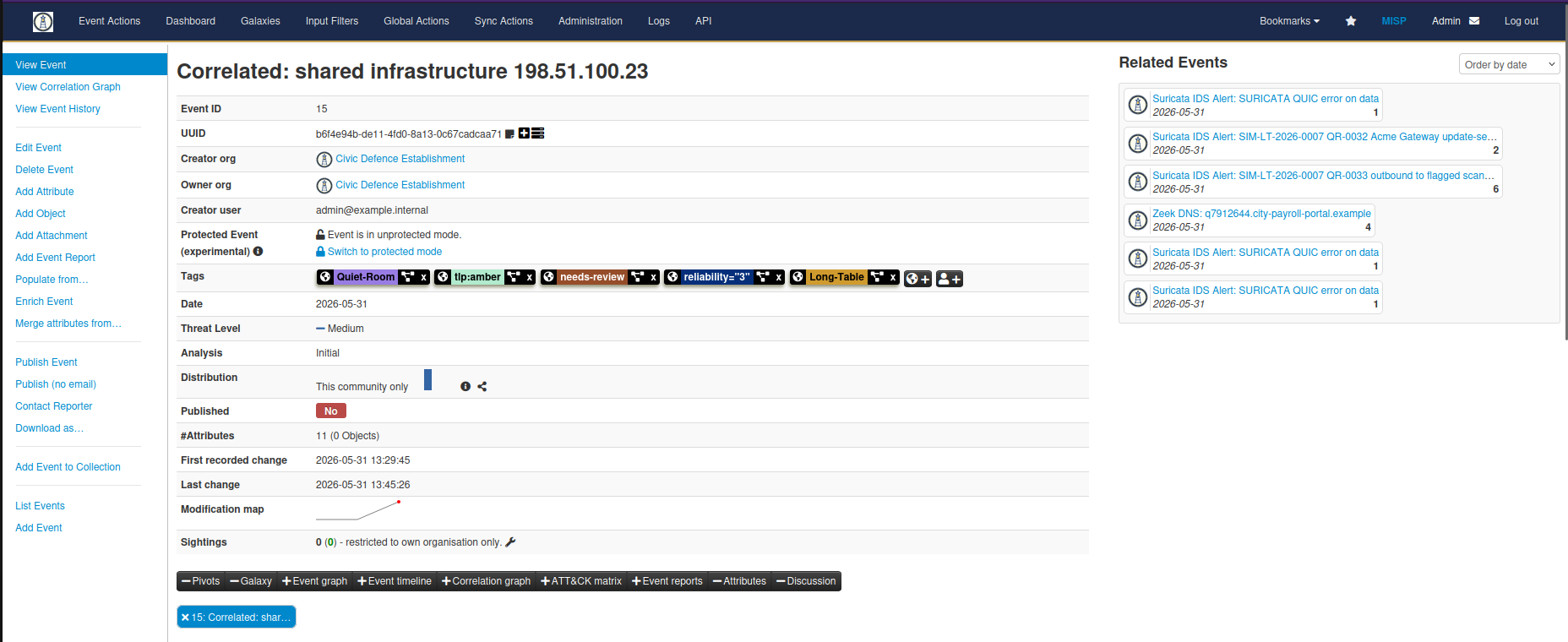
Tags: Quiet-Room, Other, reliability="3", tlp:amber
tlp:amber because the internal host sits on a monitored operational segment, which the analyst
confirmed. The combination, unlike either part, concerns named infrastructure.
Attributes:
Type |
Value |
Note |
|---|---|---|
ip-src |
198.51.100.23 |
internal host |
domain |
(look-alike payroll domain) |
newly registered, deceptive |
datetime |
day of intake |
two sensor events, seconds apart |
text |
QR-2026-0033 |
internal reference |
The two source events are attached. The Quiet Room records the sequence; it does not expand the DNS or connection content into a timeline. That is the Long Table’s decision.
What the Quiet Room does not do
It does not route either event on its own. Neither crossed the threshold alone, and the correlation is recorded as the reason the combined material did, not retrofitted onto either part.
It does not investigate the internal host. An address that followed a lure may warrant a look at the endpoint. The Quiet Room passes that observation upward and does not act on it.
It does not attribute the domain registration or the external range. Whether this is one actor, a commodity kit, or coincidence is not characterised here.
Case record status
Field |
Value |
|---|---|
Status |
Correlated, routed to Long Table |
MISP event |
QR-2026-0033 (tlp:amber, reliability 3) |
Basis |
Two reliability 2 sensor events, correlated |
Analyst review |
Completed same day |
The combination is routed. Either event alone would have been held or dropped.
[^domain]: In the screenshot the domain reads `q<id>.city-payroll-portal.example`. The leading `q<id>`
    label changes between captures and carries no meaning for the case; the look-alike domain itself is
    `city-payroll-portal.example`. The prose stays generic because the prefix is an artefact of capture,
    not a feature of the finding.
Last updated: 01 June 2026