Who is in, and how firmly
The arrangement has no membership list on any wall, which is convenient, because the honest answer to who belongs is layered. Some powers are in to the hilt. Some are in for commerce and would deny the defence part in daylight. One is so large and so close that nobody can quite say whether it is inside the tent or the reason the tent was pitched. The tiers below are the city’s working picture, not a charter.
The core
The heart of the arrangement is the cluster of Sto Plains powers already wired into the same commercial nervous system: Ankh-Morpork, Sto Lat, Pseudopolis, and Quirm. These are the capitals the clacks, the banks, the railways, and the newspapers have knitted together until a shock to one is felt in the others before the post arrives.
Ankh-Morpork leads, though leads is a generous word for what is closer to gravitation. It does not command the others. It is simply the city their traffic already passes through, the place that holds the scheme and runs most of the crossings, and the hardest member to route around. Leadership by being unavoidable is more durable than leadership by treaty, and harder to resent openly.
The most modern form of this is the quietest. Every member runs sovereign services of its own and still leans, for anything at scale, on Golem Trust Computing: the Ankh-Morpork firm whose golems carry the routine compute of half the Circle Sea. The dependency is mutual on paper and asymmetric in practice, because a golem works on the word in its head, and the word was written under the firm’s arrangements. A member can hold its own walls and still find that the thing inside them answers, in the end, to a yard in the Shades. Nobody in the city has to say so. It is the lever Vetinari never has to pick up.
Quirm sits in the core with its own ideas about everything, a more genteel and more continental sensibility, and a long habit of agreeing with the city in public while arranging matters to its own taste in private. A core member is not the same as a compliant one.
The hill members
Lancre and the Ramtops states are in, junior and proud about it. Small, mountainous, and easy to overlook on a map, they sit across the passes and at the head of the clacks lines that climb into Uberwald, which gives them leverage out of all proportion to their size. A power that can slow the traffic over a mountain has a vote whether or not anyone wrote it down.
They are also the members least inclined to be told. A hill kingdom that has governed itself through several centuries of larger neighbours having opinions does not take direction from the Sto Plains gracefully, and tends to honour the arrangement on its own reading of it.
The partners
Past the core sit the powers that are in for trade, are modernising into the arrangement, and would describe the relationship in commercial terms if asked.
Uberwald is the awkward case. The modernising factions around the Low King and the newer vampire leadership are firmly in, and the fat reserves the arrangement would rather not discuss make the integration mutual. But Uberwald is not one thing. It is dwarf and troll and vampire and werewolf and a great deal of forest, and its own factions do not all agree it is a member at all. It is a partner whose internal disputes the arrangement inherits whether it wants to or not, and the dwarf-troll fault line runs straight through it.
Genua is in at arm’s length, reached by trade route more than by treaty, distant enough that the relationship runs on shipping and remittance. Ephebe is the partner with ideas: coastal, philosophical, possessed of a long memory and a longer list of old quarrels with its own neighbours, useful for exactly the reasons it is occasionally exasperating.
Fungolia
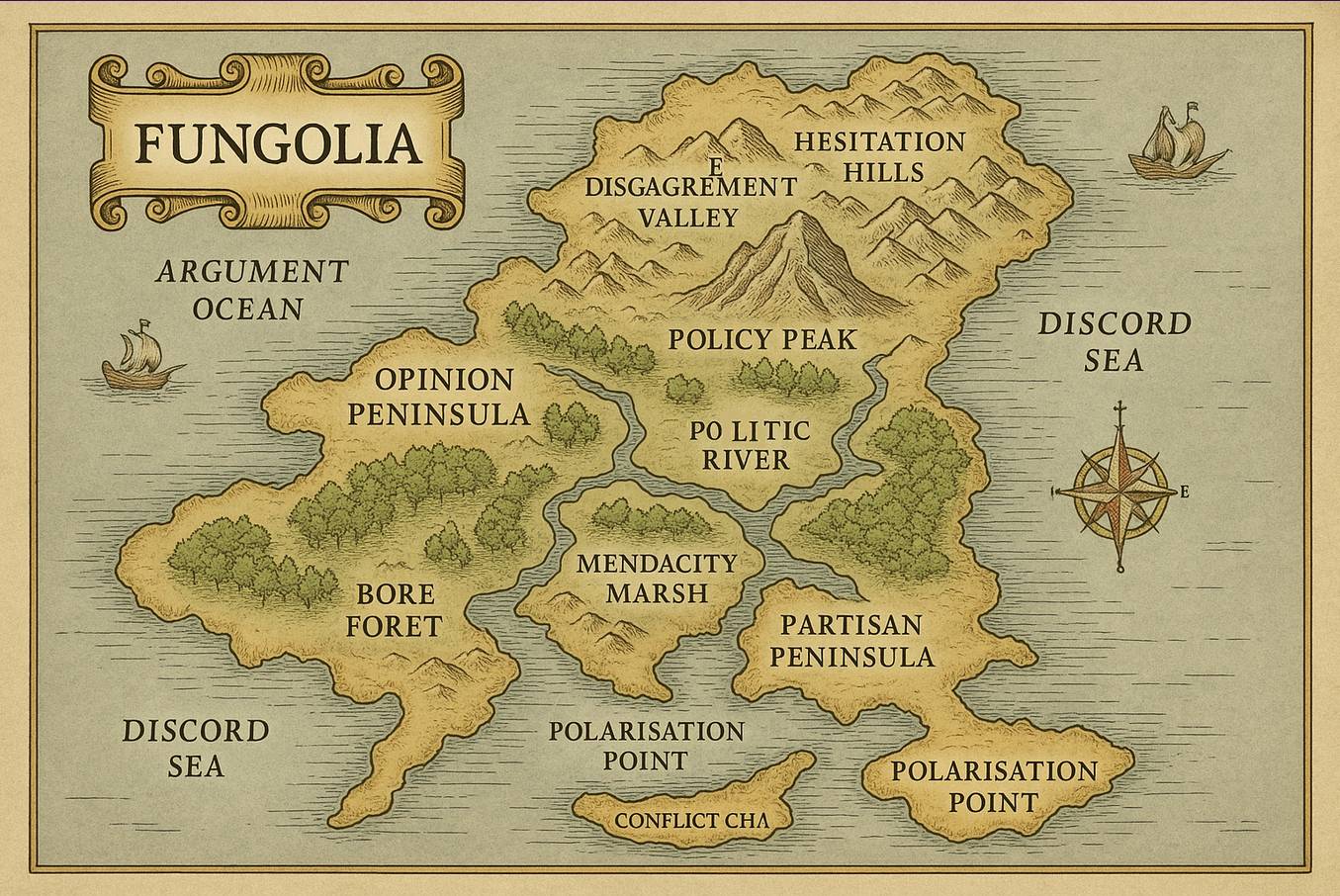
Fungolia is the closest of the Circle Sea powers, and the most watched. Both halves of that are true at once, and the second follows from the first.
The arrangement is real and the sharing is real. The Fungolian observer post, which signs nothing and attends everything, is on paper a partner with standing: cleared to hold the city’s restricted material by right, present at the assessments, party to the scheme. None of that is a fiction the city maintains reluctantly. It is the relationship working as designed.
The standing question, the one no document in the arrangement frames, is the same as it has always been. The shared scheme means Fungolia can hold the city’s restricted material by right. Which of it the post then reads more closely than holding requires, and which capital reads the post’s letters home, is not a question the arrangement was ever built to answer. The ally with the most legitimate access is, for that exact reason, the one worth watching most closely. There is no version of the arrangement that grants the access without granting the exposure, because they are the same grant.
What the exposure runs on, in practice, is four bodies that between them hold Fungolia’s wires, and each turns up in the city’s casework for a reason of its own. The Ministry of Digital Affairs is the regulator and registrar, allocating the country’s spectrum and address blocks and, with some ceremony, scheduling the committees that ratify such things; it is also the body that reconstructs the breach when one of Fungolia’s ministries is opened up, which it does at the stately pace of a bureaucracy required by law to disagree with itself before it acts. FungusFiber Internet is the country’s sole regional registry and main provider, a network whose firmware suggests an intention to update it somewhere around 2019, and the registry whose routes the city’s own traffic to the frontier happens to ride. MycoSec Labs handles security research and consultancy from a sprawl of chambers under the capital, which is also, by treaty, where a good deal of the city’s mirrored material sits. OpenHands International runs digital-rights monitoring out of a converted underground library, an NGO whose field reporting tends to interest certain services rather more than its funding would suggest.
None of the four was built to be a frontier of the alliance, and all four are. The city’s exposure to Fungolia is less an abstraction filed under the observer post than these specific wires, run by these specific bodies, on the usual Fungolian blend of good intentions and deferred maintenance.
Klatch
Klatch is the member nobody will quite classify. It is large, powerful, and economically integrated, a trading partner the city cannot do without and a rival the city cannot stop measuring itself against. Whether it sits inside the arrangement or stands as the reason the arrangement exists is a question every capital answers differently, and the arrangement has been careful never to ask it out loud.
This is deliberate. An arrangement that named Klatch a member would have to defend the claim the next time the two powers fell out over a trade route or a stretch of coast. An arrangement that named Klatch an outsider would have to explain why so much crosses between them anyway. The useful position is the unresolved one: partner enough to share with, rival enough to watch, and too entangled with to do without. The city has held that position for a very long time, and intends to go on holding it.
Where the pressure sits
A hill member slows the traffic over a pass to make a point, and a question of local pride becomes a question of whether the clacks reach Uberwald.
A partner’s factions disown its membership at the moment the arrangement most needs it to hold, and Uberwald is simultaneously in and not in.
The rival who is also a partner withholds something the city had stopped noticing it relied on.
The dwarf-troll grievance is reheated down the deep mines, and a peace that was quiet becomes ruinous before anyone upstairs has finished the morning’s post.
A core member agrees in public and arranges matters privately, and the arrangement discovers a decision was taken without it.
Last updated: 09 July 2026