EtherNet/IP
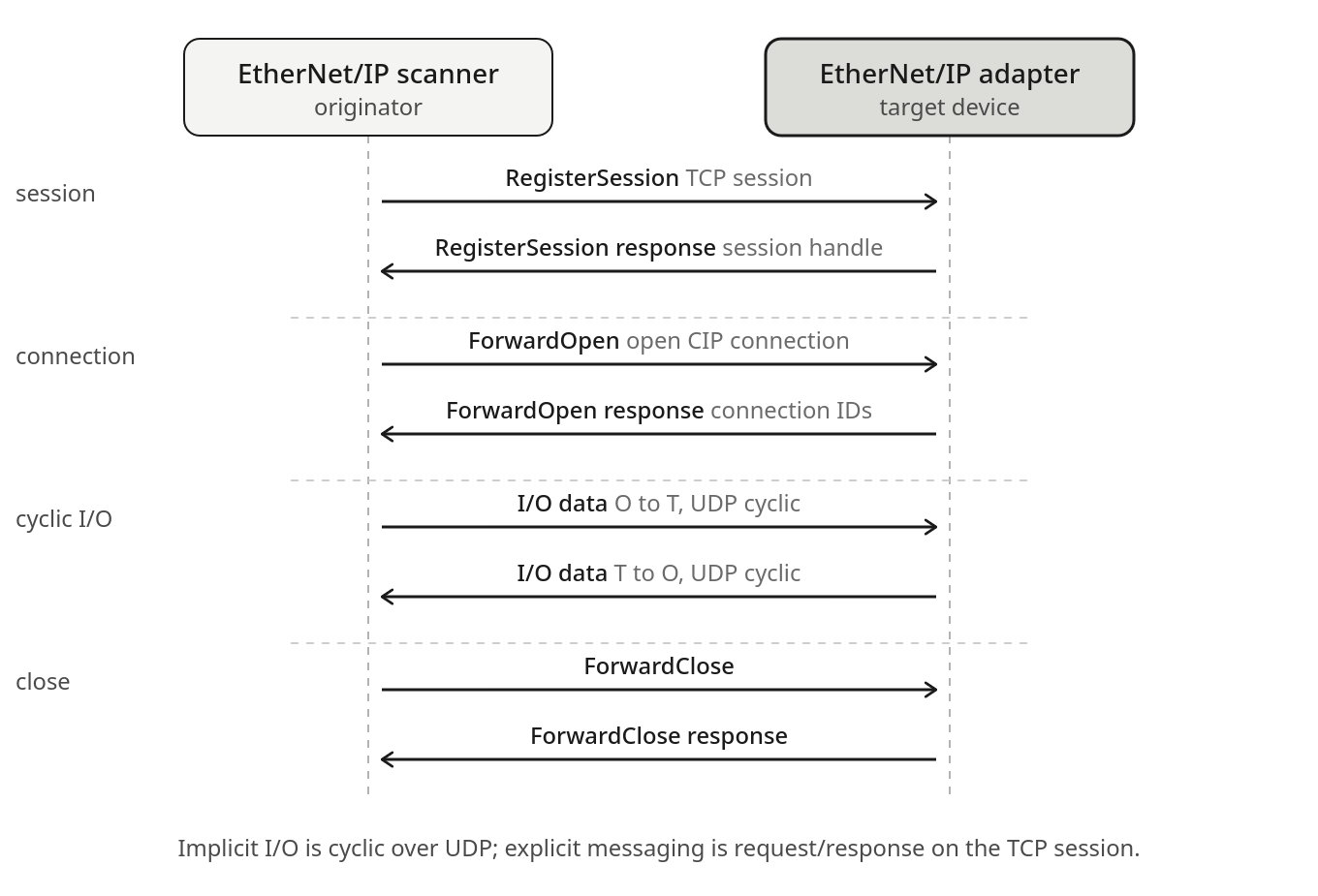
EtherNet/IP is CIP carried over Ethernet, and its character is the split down the middle of the diagram. RegisterSession returns a session handle, which is a routing token: it identifies the conversation, it does not authenticate the originator. Explicit messaging then runs request/response over TCP for configuration and diagnostics, each SendRRData wrapping a CIP service. ForwardOpen is the pivot. It asks the Connection Manager to set up a Class 1 connection at a requested packet interval, and once that exists the actual process data leaves TCP entirely and runs as cyclic UDP in both directions. For a threat model the two halves differ: the explicit TCP side is reachable and unauthenticated in classic deployments, and CIP Security, the later TLS and DTLS profile, is the part that has to be deliberately enabled.
Development
EtherNet/IP (Ethernet Industrial Protocol) was developed by Rockwell Automation and published by ODVA in 2001. It runs the Common Industrial Protocol (CIP) over standard TCP and UDP, making it the dominant OT protocol for discrete manufacturing in North America and widely deployed in automotive, food and beverage, and packaging industries. Its use of standard Ethernet and IP means it coexists on the same physical infrastructure as IT networks more readily than older serial protocols, which is both its operational advantage and its security liability.
CIP and the object model
CIP is the application-layer protocol that EtherNet/IP carries. It defines an object model where every device exposes a set of objects, each with attributes that can be read or written and services that can be invoked. The Identity Object ( class 0x01) returns vendor name, device type, product code, revision, and serial number. The Connection Manager Object handles the establishment of I/O connections and explicit messaging connections.
EtherNet/IP uses two transport mechanisms. Explicit messaging runs over TCP port 44818 and is used for configuration, parameterisation, and on-demand data reads and writes. Implicit messaging (I/O messaging) runs over UDP port 2222 using a producer-consumer model: a PLC and an I/O device establish a connection, and the device produces data at a configured rate which the PLC consumes. The I/O data in an implicit messaging connection maps directly to PLC input and output tags.
There is no authentication in the base CIP specification for either explicit or implicit messaging. Any device that can reach TCP port 44818 can read device identity, read and write configuration parameters, and issue CIP service requests including Forward Open (establish an I/O connection) and Reset (reboot the device).
Identity Object, Forward Open, Reset
The Identity Object is the standard reconnaissance starting point. The nmap enip-info script queries it
without authentication:
nmap -p 44818 --script enip-info --open 10.0.0.0/24
This returns vendor, product name, firmware revision, and serial number for every EtherNet/IP device on the segment. The pycomm3 library goes further — it can read and write PLC tags over the same unauthenticated explicit messaging connection:
from pycomm3 import LogixDriver

with LogixDriver('10.0.0.40') as plc:
    print(plc.get_module_info())       # Identity Object, no credential
    print(plc.read('Motor1_Speed'))    # read a process tag
    plc.write(('Conveyor_Run', False)) # write an output tag — no auth
Forward Open requests establish I/O connections. An attacker who can send a Forward Open to a drive or I/O module can establish an implicit messaging connection and begin producing data to that device’s output tags. On a drive, those output tags include the reference speed and run/stop command. The legitimate PLC’s existing connection may be displaced or coexist, depending on the device’s connection handling.
The Reset service (CIP service 0x05 on the Identity Object) reboots the device. It requires no authentication on most implementations and is a straightforward availability attack.
CIP Security
CIP Security, published by ODVA in 2018, adds TLS for explicit messaging over TCP and DTLS for implicit messaging over UDP. It provides device authentication via certificates, message integrity, and confidentiality. The security profile is negotiated during connection establishment; a device that supports CIP Security can enforce that connections use it.
Deployment is limited. CIP Security requires support in both the originator (typically a PLC or engineering workstation) and the target device. Rockwell’s ControlLogix 5580 and CompactLogix 5380 families support it; support across the broader EtherNet/IP device ecosystem is uneven. Existing installations cannot retrofit CIP Security to devices that do not support it in firmware.
For new installations specifying EtherNet/IP, including CIP Security requirements in device procurement is the practical path. For existing installations, the compensating controls are network-based.
Ports, segments, and what gets through
EtherNet/IP uses known ports: TCP 44818 for explicit messaging, UDP 44818 for ListIdentity, UDP 2222 for implicit messaging. Restricting them to known sources is the first and most direct control:
# Explicit messaging: permit only engineering workstation and SCADA master
iptables -I INPUT -p tcp --dport 44818 -s 10.0.10.0/24 -j ACCEPT
iptables -A INPUT -p tcp --dport 44818 -j DROP
# Implicit I/O: permit only the PLC controller
iptables -I INPUT -p udp --dport 2222 -s 10.0.20.5/32 -j ACCEPT
iptables -A INPUT -p udp --dport 2222 -j DROP
The implicit messaging connections between PLCs and I/O devices typically stay within a single control VLAN and do not cross the IT/OT boundary. Isolating these connections at the VLAN level means an attacker who has reached the corporate network cannot establish I/O connections directly.
Managed switches that support port-based access control can restrict which MAC addresses originate traffic on process network ports, limiting the ability of a new device physically connected to the network to participate in EtherNet/IP communication.
Network monitoring tools that baseline normal EtherNet/IP traffic patterns can alert on new CIP connections, Forward Open requests from unexpected sources, and Reset service requests. Rockwell’s Cisco partnership and the ODVA ecosystem include several tools that provide this visibility.
Rockwell-specific considerations
A significant proportion of EtherNet/IP deployments run Rockwell PLCs managed by Studio 5000 Logix Designer. The PLC’s Ethernet port uses EtherNet/IP for both I/O communication and programming. A Logix PLC with its Ethernet port reachable from outside the OT network is reachable for program uploads and downloads. The PLC password feature (available on ControlLogix and CompactLogix) protects against unauthorised downloads; it is not enabled by default and is distinct from any network-level access control.
The ENIP/CIP scanning and exploitation tooling in publicly available frameworks (including Metasploit modules and purpose-built tools such as cpppo and pycomm3) means that reaching port 44818 on an unprotected PLC translates to capability quickly. Network access is the critical control.
Related
Profinet: the European counterpart; same Ethernet-native design, similar cyclic/acyclic split and similar attack surface
Modbus: the simpler field protocol; same no-auth baseline, simpler compensating controls
IEC 62351: CIP Security follows a similar TLS-over-TCP model to IEC 62351 Parts 3 and 4
ODVA: publishes the EtherNet/IP and CIP specifications
Shodan: port 44818: internet-exposed EtherNet/IP devices
Last updated: 10 July 2026